How Does a 40 Foot Scissor Lift Improve High-Level Access
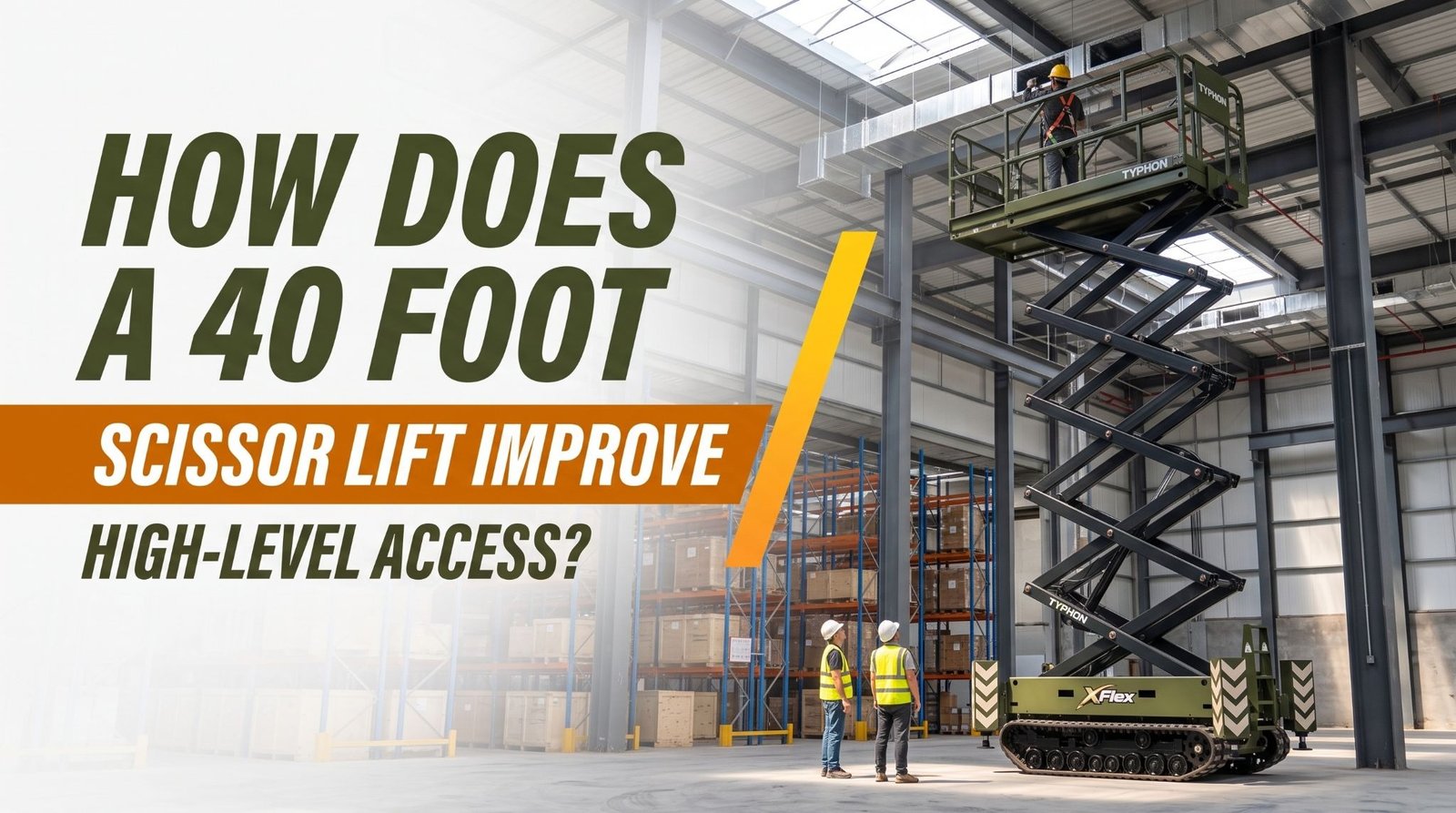
There comes a point on many job sites where the work simply sits too high for the equipment on hand. A ceiling truss, a warehouse mezzanine, the upper reaches of a stadium wall, or a bank of lights suspended over an arena floor all sit beyond the comfortable reach of a smaller lift. Crews then face awkward choices: stack scaffolding, rent a specialized machine, or leave the job half-finished. A 40-foot scissor lift closes that gap. It carries workers, tools, and materials to a genuine four-story working height on a broad, stable platform, turning tasks that once demanded elaborate setups into a straightforward lift, roll, and work routine.
Reaching that height changes what a single machine can accomplish across a shift. Instead of repositioning scaffold towers or renting several pieces of equipment, a crew rolls the lift into place, raises the platform, and gets to work with both hands free and everything they need at deck level. This post looks at how a 40-foot model reaches where standard lifts fall short, how it serves construction, warehousing, facility maintenance, and events, how its platform size and capacity drive productive work aloft, how it stacks up against boom lifts and shorter scissor lifts indoors and out, how it holds steady and safe at full extension, and how to match one to the real demands of your work.
How a 40-Foot Lift Reaches Where Standard Lifts Fall Short
Most compact and mid-size scissor lifts top out somewhere between 20 and 32 feet of platform height, which suits a great deal of everyday work but leaves the highest tasks out of reach. A 40-foot scissor lift extends its platform to roughly 40 feet, which places a worker’s hands closer to 46 feet of actual working height once you account for a person’s reach above the deck. That extra elevation is exactly what separates the tasks a standard lift can finish from the ones it cannot. Where a 26-foot machine leaves a worker straining below a high ceiling or reaching from the top rail, the 40-foot model brings them level with the work.
The difference comes from the extended scissor mechanism, the crossed steel legs that fold and unfold to raise the platform. A 40-foot lift uses more sections and a longer stroke to gain its added height, all while lifting straight up rather than reaching outward. That vertical travel is the key: it delivers substantial height without the machine needing a wide operating radius or an outreaching arm. For work that sits directly overhead on firm, level ground, few machines match the straightforward vertical reach a 40-foot scissor lift provides.
How Different Industries Put That Height to Work
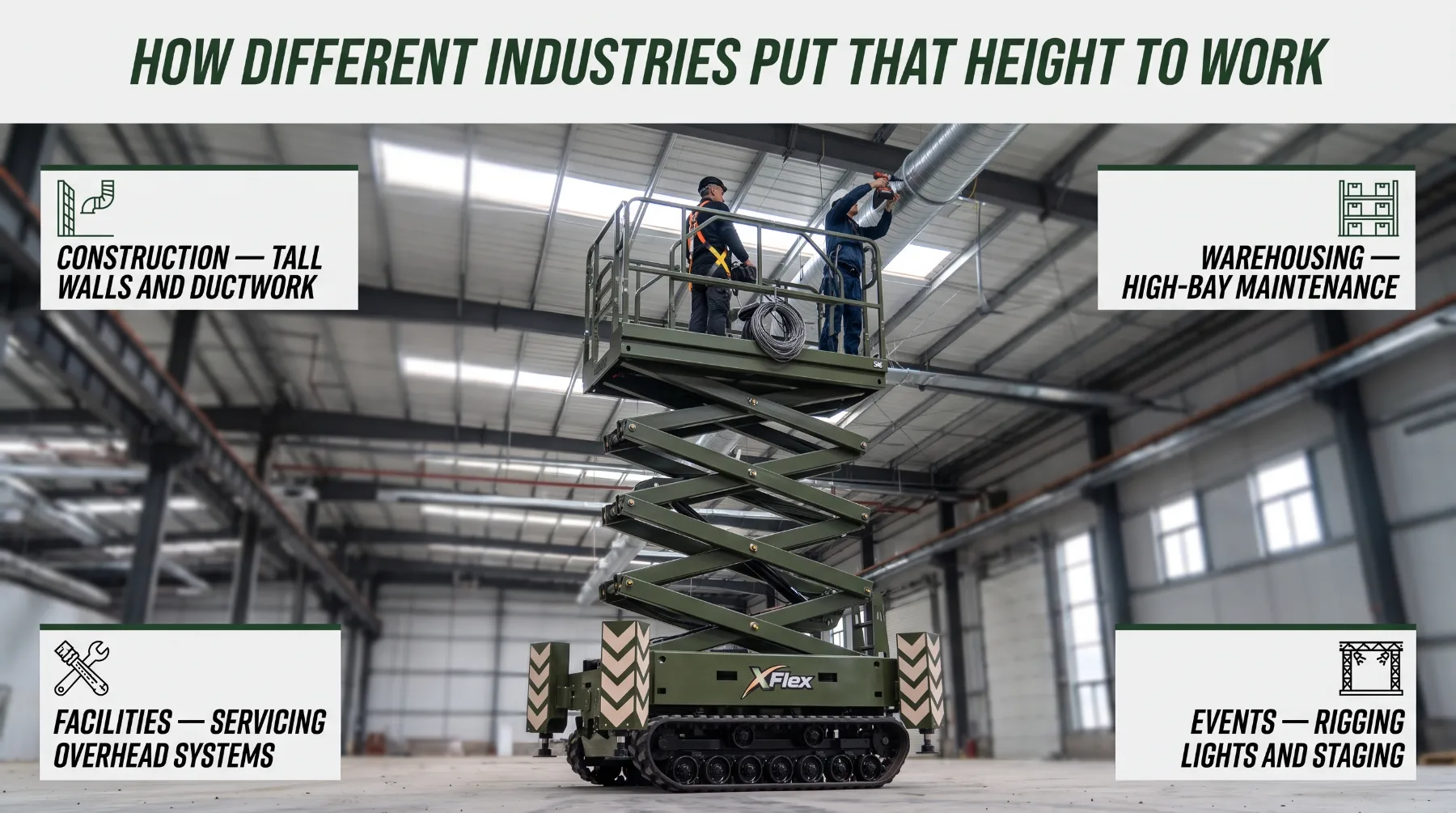
The value of a 40-foot lift shows up wherever the work climbs high, and few sectors feel that more than construction. On commercial builds, crews use the machine to install and finish tall interior walls, run ductwork and conduit near high ceilings, mount structural steel connections, and handle drywall and painting at elevations that scaffolding would take hours to service. Because the platform lifts straight up and rolls between positions, a crew moves along a wall or ceiling line far faster than they could by dismantling and rebuilding a scaffold tower at each new spot.
Warehousing and distribution put the same height to different uses. High-bay storage, overhead conveyor systems, sprinkler lines, lighting, and building services all sit near the roof of a large facility, and a 40-foot lift reaches them without interrupting the racking below. Maintenance teams rely on that reach constantly, servicing HVAC units, replacing high-mounted fixtures, cleaning and inspecting structures, and keeping tall interiors in working order. The events and entertainment world leans on it too, rigging lighting, sound, banners, and staging high above arena floors, exhibition halls, and theaters where the work is temporary but the height is very real. Across all of these, the common thread is simple: when the task lives near the roof, a 40-foot lift brings the crew to it safely and quickly.
How Platform Size and Capacity Support Productive Work
Reaching height is only half the story, because what a crew can actually accomplish up there depends on the platform beneath their feet. Many 40-foot scissor lifts offer a generous deck, often with an extending roll-out section that lengthens the working area, so two workers can stand side by side with room for tools and materials. That space matters more than it might seem. A cramped platform forces workers to descend repeatedly for supplies, and every trip down and back up eats into the day. A roomy deck lets a crew carry what they need for a stretch of work and stay aloft, turning wasted transitions into productive time.
Capacity works hand in hand with size. A 40-foot lift is typically rated to carry several hundred pounds, enough for a team plus their equipment and a reasonable load of materials, though the exact figure varies by model and must be read from the machine’s data plate. That rated capacity is what lets the platform serve as a genuine mobile workstation rather than a simple perch. When the deck holds the people, the tools, and the materials a task requires, the work flows without constant resupply. The combination of a wide platform and dependable capacity is what turns raw height into real output, since a crew that can stay up and stays stocked finishes far more in a shift than one shuttling endlessly to the ground.
How It Compares to Boom Lifts and Shorter Scissor Lifts
Set a 40-foot scissor lift beside a boom lift, and the trade-off comes into focus. A scissor lift raises a large, stable platform straight up, which makes it ideal for work directly overhead where a spacious deck and vertical reach matter most. A boom lift, by contrast, extends an arm that can reach up and out, swinging over obstacles to place a smaller basket in spots a scissor lift cannot approach. When the work sits above ground, you can position the machine beneath; the scissor lift wins on platform space, capacity, and value. When the work hides behind an obstruction or demands outward reach, the boom lift’s articulating arm earns its higher cost and complexity.
Compared with shorter scissor lifts, the 40-foot model is purpose-built for tasks the smaller machines cannot touch. A 19-foot or 26-foot lift moves nimbly, fits tight indoor spaces, and costs less, so it remains the sensible pick for lower work. But it simply cannot deliver the four-story reach that high ceilings, tall storage, and overhead rigging demand. Indoor and outdoor use adds another layer to the choice. Electric 40-foot scissor lifts run clean and quiet for indoor and finished-floor work, while rough-terrain models handle outdoor ground and job sites, so the right version depends on where the height is needed. The honest approach is to match the machine to your tallest routine task and the surface you work on, choosing a 40-foot scissor lift when vertical reach and platform space dominate, and looking elsewhere only when outward reach or lower height, defines the job.
How Stability and Safety Features Perform at Full Height
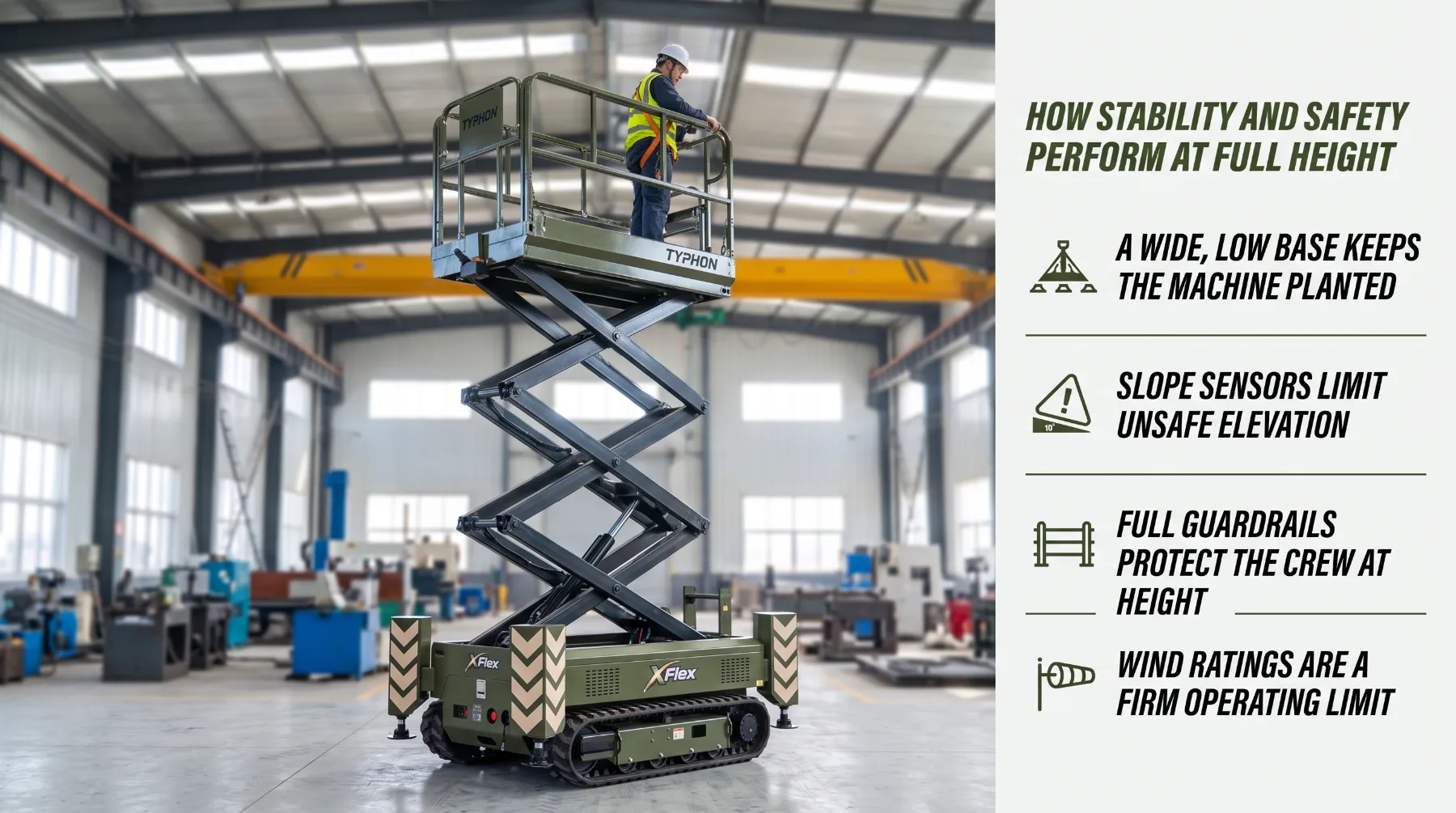
Height raises the stakes, and a well-built 40-foot scissor lift is engineered to stay planted and secure at full extension. Stability begins with the machine’s wide, heavy base and low center of gravity when lowered, and it carries upward through a scissor structure designed to hold the platform steady as it climbs. These machines are rated to elevate on firm, level ground, and many carry a system that checks the slope of the ground and prevents or limits elevation when the surface sits outside safe limits. That safeguard matters most at 40 feet, where even a modest tilt at the base is magnified at the platform, so the machine is built to refuse an unsafe lift rather than attempt one.
The platform itself is surrounded by full guardrails and toe boards that protect workers throughout the lift, and the deck stays level as it rises so the crew keeps secure footing. Controlled hydraulic raising and lowering, along with an emergency lowering function, keep the descent smooth and predictable. Outdoor-rated models publish a maximum wind speed, and that figure is a firm operating limit, since a raised platform catches wind more strongly the higher it climbs. Operating within the rated capacity, on suitable ground, within any wind and slope limits, is what lets these safety features do their job. Used as designed, a quality 40-foot scissor lift gives crews a stable, secure place to work four stories up, but that security depends on respecting the limits the machine is built around.
Conclusion
A 40-foot scissor lift improves high-level access by solving a problem that smaller equipment leaves unfinished: reaching roughly four stories of straight-up working height on a broad, stable platform that carries a full crew and its materials. Its extended scissor mechanism lifts vertically where standard machines fall short, and industries from construction to warehousing, facility maintenance, and events all put that reach to work on high walls, ceilings, storage, and overhead rigging. A spacious deck and dependable capacity turn that height into sustained productivity, while a wide base, self-leveling safeguards, full guardrails, and firm operating limits keep crews secure at full extension. Match the machine to your real heights, loads, and surfaces, operate it within its rated limits, and a 40-foot scissor lift becomes a dependable foundation for high work rather than a machine pushed beyond its purpose.
Frequently Asked Questions
What is the actual working height of a 40-foot scissor lift?
The 40-foot figure refers to the platform height, not the worker’s reach. With a person’s reach added, the practical working height is roughly 46 feet. Always check the model’s rated platform height and compare it with the actual height of the task.
Can a 40-foot scissor lift be used both indoors and outdoors?
It depends on the model. Electric versions are suited to indoor work because they operate quietly and without exhaust, while rough-terrain models are designed for uneven outdoor ground and typically offer greater clearance and stronger traction. Always confirm the machine’s rating and intended operating environment before use.
How much weight can a 40-foot scissor lift carry to full height?
Capacity varies by model and is listed on the machine’s data plate. Many can carry multiple workers, tools, and materials, but the allowed load may change when the platform extension is used. Never exceed the rated capacity, and include all workers, tools, and materials when calculating the total load.